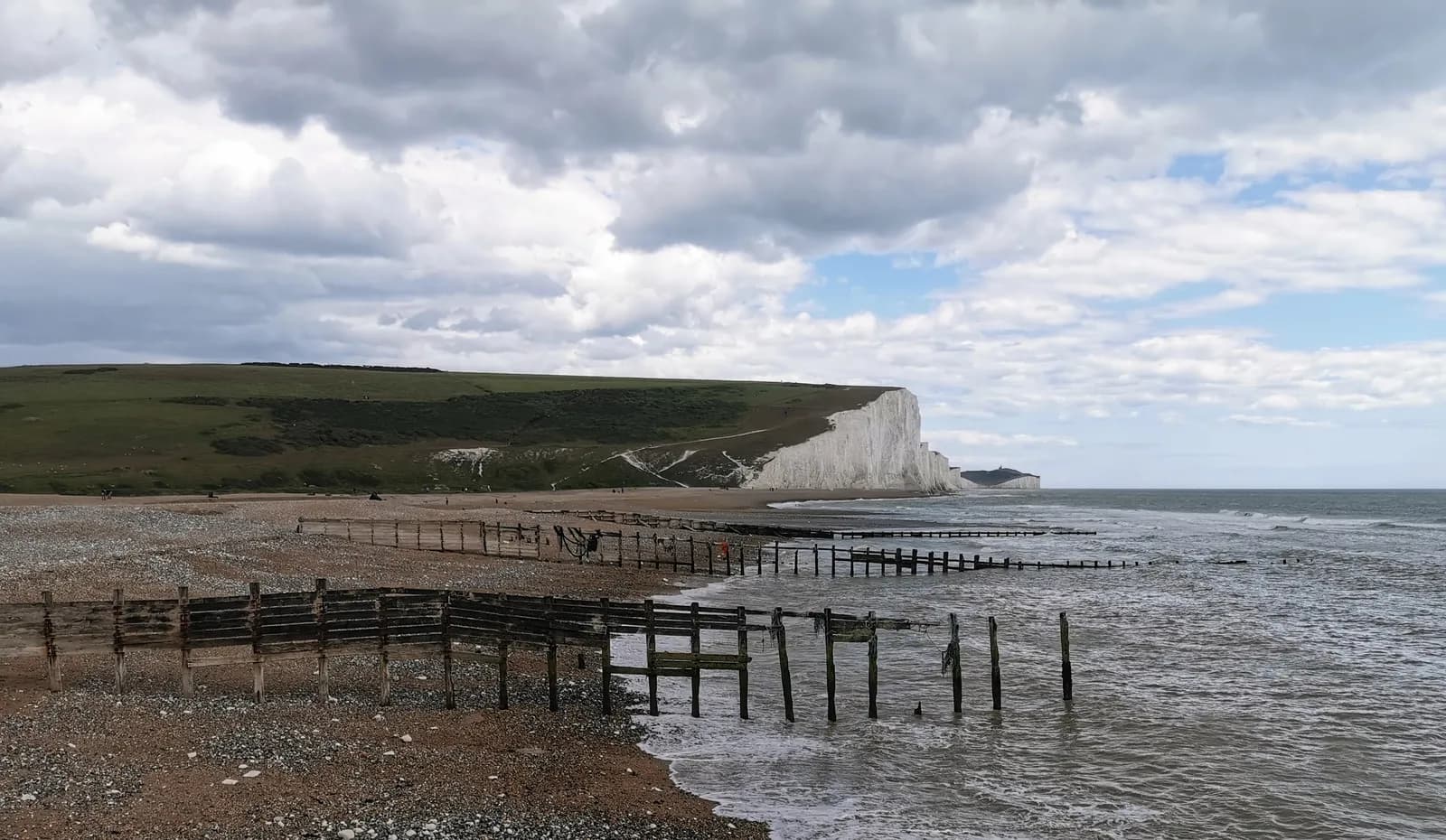
The Seven Sisters rise above the English Channel in brilliant white tiers, a stretch of chalk coastline between the River Cuckmere and Beachy Head that has become East Sussex's most recognisable landscape. These cliffs attract filmmakers, photographers, and walkers from across the globe, drawn by their unspoilt brightness and the dramatic undulation of seven distinct peaks.
The Formation of an Icon
The Seven Sisters comprise seven chalk crests: Haven Brow, Short Brow, Rough Brow, Brass Point, Flagstaff Point, Flat Hill, Baily's Hill, and Went Hill Brow. Each peak is separated by a dip or swale, remnants of dry valleys in the chalk South Downs that the sea has gradually worn away. The cliffs are composed of chalk formed during the Late Cretaceous period, between 100 and 66 million years ago, when microscopic algae skeletons settled on ancient seabeds. Flint nodules remain embedded within the strata, visible to those walking the cliff-top paths.
The coastline here is in constant flux. The cliff edge retreats at an estimated 30 to 40 centimetres each year as the chalk crumbles into the Channel. An eighth sister is currently forming through this relentless erosion, a reminder that the landscape is not a fixed monument but a living, shifting entity.
A Landscape Saved from Development
The Seven Sisters might have looked very different today. In 1926, plans emerged to build a new town on these cliffs. A coalition of conservationists, including the writer Rudyard Kipling, campaigned vigorously against the proposal. Within a single month, supporters raised approximately £17,000, equivalent to roughly £509,000 in modern terms, to purchase the land and secure it for public enjoyment.
This early preservation effort established a protective ethos that continues today. The cliffs now form part of the Seaford to Beachy Head Site of Special Scientific Interest, recognised for both its biological and geological significance. The surrounding area falls within the South Downs National Park, designated in March 2010 and fully operational from April 2011.
Ownership and Investment
On 30 July 2021, the South Downs National Park Authority took ownership of the Seven Sisters Country Park. The Authority pledged nearly £2 million to improve habitats and create what it described as a world-class visitor centre. The park itself spans 280 hectares of chalk downland, flood meadow, and cliffs, bounded inland by the A259.
The National Trust manages Birling Gap and the coastline between Seaford and Eastbourne. At Birling Gap, coastguard cottages built in 1878 demonstrate the impact of coastal erosion: several have been demolished as the cliff edge advanced, though others remain inhabited. An Iron Age hillfort once stood here; approximately half has already been lost to the sea.
The River Cuckmere and Cuckmere Haven
The River Cuckmere rises near Heathfield and travels 32 kilometres to reach the English Channel at Cuckmere Haven. This estuary marks the western end of the Seven Sisters and represents the only undeveloped river mouth on the entire Sussex coast. The lower course meanders across a floodplain that serves as a nature reserve, offering a rare example of a natural estuarine system in a heavily developed region.
At high tide, the river mouth reaches depths of six to seven metres with a strong current. The Seven Sisters website warns that crossing here is dangerous. The Cuckmere Estuary Partnership, established in 2001, has proposed restoring the estuary to its natural state through controlled flooding. This plan has generated local controversy, with groups such as Rescue the Cuckmere Valley opposing aspects of the scheme. The debate illustrates the tension between ecological restoration and community interests that shapes much modern conservation work.
Hollywood on the Sussex Coast
The Seven Sisters appear in more films and television programmes than many working actors. Productions including Robin Hood: Prince of Thieves, Atonement, Harry Potter and the Goblet of Fire, The Hitchhiker's Guide to the Galaxy, Mr. Holmes, Summerland, and Anatomy of a Scandal have all used this coastline as a backdrop. The 2019 film Hope Gap, starring Bill Nighy and Annette Bening, took its title from the chalk cliff section between Seaford and Cuckmere Haven.
More recently, the cliffs appeared in The Walking Dead: Daryl Dixon and the 2024 production of Wicked. Their popularity with location scouts stems from their unspoilt character. Unlike the White Cliffs of Dover, which have become increasingly covered in vegetation due to active protection of the port area, the Seven Sisters remain bright white because they are allowed to erode naturally. They contain no anachronistic development, making them a convincing visual substitute for Dover in period dramas and historical films. An east-facing photograph of the cliffs even appears as a default wallpaper in Microsoft Windows 7, ensuring the Sussex coastline has graced millions of computer screens worldwide.
Visiting the Seven Sisters
The Seven Sisters Country Park offers facilities for visitors at Exceat, including a visitor centre, shop, toilets with a Changing Places facility, and the independent Saltmarsh Café. Car parks operate on a pay-and-display basis at both the North (forest) and South (riverside) locations; motorbikes park free of charge.
The South Downs Way National Trail runs along the cliff edge, providing walkers with panoramic views across the Channel. The cliffs sit within the Sussex Heritage Coast and the South Downs National Park, which received International Dark Sky Reserve status in 2016. The park stretches 140 kilometres from Winchester to Eastbourne, covering 1,627 square kilometres, and received approximately 18 million visitors in 2024.
Birling Gap beach earned the Blue Flag rural beach award in 2005. The area contains 86 Sites of Special Scientific Interest and 13 international Special Areas of Conservation, supporting rare orchids, butterflies, and other species dependent on chalk grassland habitats.
Ancient History Beneath the Chalk
The Seven Sisters landscape bears traces of human activity spanning millennia. At Exceat, where the visitor centre now stands, a Saxon fishing village once served as one of King Alfred's naval bases. The village was abandoned following the Black Death in the 1400s. Today, only a single stone from the former church remains visible.
This layering of history, from Cretaceous seabeds to Saxon naval power to twentieth-century conservation campaigns, gives the Seven Sisters their particular resonance. They are not merely a scenic backdrop but a landscape that carries the marks of deep time, geological process, and human effort. The cliffs continue to erode, the film crews continue to arrive, and walkers continue to follow the South Downs Way along the edge where Sussex meets the sea.